Anaconda Movies in order Anaconda Marathon

Marathon Details
Page Last Modified:
7 April 2026
Most Recent Release:
Anacondas: Trail of Blood - 2009
Total Runtime:
366 Minutes
Total Items:
4
Average User Score:
(5)Watching orders for Anaconda
Anaconda Movies in order
-
 1
Anaconda Movie 90 min. 1997A 'National Geographic' film crew is taken hostage by an insane hunter, who takes them along on his quest to capture the world's largest — and deadliest — snake.USER SCORE 5
1
Anaconda Movie 90 min. 1997A 'National Geographic' film crew is taken hostage by an insane hunter, who takes them along on his quest to capture the world's largest — and deadliest — snake.USER SCORE 5 -
 2
Anacondas: The Hunt for the Blood Orchid Movie 96 min. 2004A scientific expedition sets out for Borneo to seek a flower called the Blood Orchid, which could grant extended life. Meanwhile, they run afoul of snakes and each other.USER SCORE 5
2
Anacondas: The Hunt for the Blood Orchid Movie 96 min. 2004A scientific expedition sets out for Borneo to seek a flower called the Blood Orchid, which could grant extended life. Meanwhile, they run afoul of snakes and each other.USER SCORE 5 -
 3
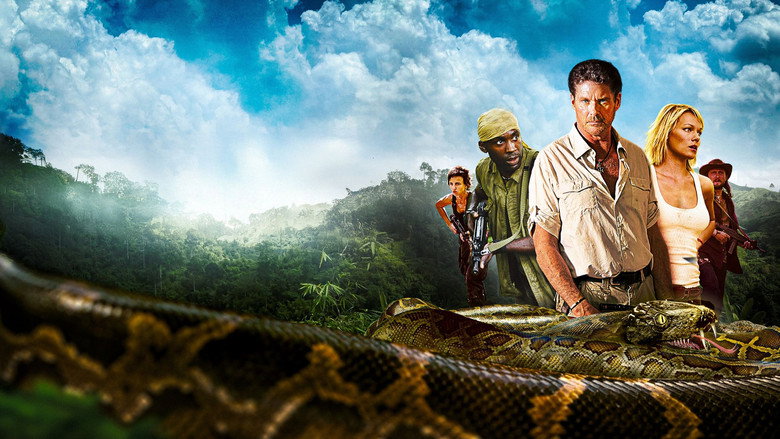
Anaconda 3: Offspring Movie 91 min. 2008A mercenary-for-hire accepts a mission from a billionaire to capture a dangerous snake that could possibly help cure a terminal illness.USER SCORE 5
3
Anaconda 3: Offspring Movie 91 min. 2008A mercenary-for-hire accepts a mission from a billionaire to capture a dangerous snake that could possibly help cure a terminal illness.USER SCORE 5 -
 4
Anacondas: Trail of Blood Movie 89 min. 2009A genetically created Anaconda, cut in half, regenerates itself into two new aggressive giant snakes, due to the Blood Orchid.USER SCORE 5
4
Anacondas: Trail of Blood Movie 89 min. 2009A genetically created Anaconda, cut in half, regenerates itself into two new aggressive giant snakes, due to the Blood Orchid.USER SCORE 5
If you are looking for a movie marathon that is easy to follow, packed with tension, and does not take itself too seriously, the Anaconda series is exactly what you need. This is a franchise that leans fully into the idea of oversized predators, dangerous expeditions, and humans making very questionable decisions in places they should probably not be.
The beauty of watching the Anaconda movies in order is that you can clearly see how the series evolves. It starts as a relatively grounded jungle thriller and slowly transforms into full-on B-movie madness with bigger snakes, wilder concepts, and higher stakes. Each film builds on the idea that nature is unpredictable, but also that humans have a habit of making things worse.
Below is the complete Anaconda movie marathon in order, with a spoiler-free look at how each film connects and escalates the chaos.
Anaconda (1997)
The journey begins deep in the Amazon rainforest, where a documentary crew sets out to film a remote and mysterious indigenous tribe. What starts as a relatively straightforward expedition quickly turns into something far more dangerous when they cross paths with a hunter who seems to know a little too much about the river and what lives beneath its surface.
This first film sets the tone for the entire franchise. It is a mix of jungle survival, suspense, and creature horror, with the anaconda itself being both a lurking threat and a force of nature that cannot be reasoned with. The tension builds slowly as the group moves further into unfamiliar territory, and the sense of isolation becomes one of the film’s strongest elements.
What makes this entry stand out is how grounded it feels compared to what comes later. The characters are mostly regular people, the setting is raw and unpredictable, and the danger feels real. The anaconda is not just a monster, it is part of the environment, blending into the river and striking when least expected.
As the film progresses, it becomes clear that the real threat is not only the snake, but also the decisions people make when fear and survival instincts take over. This foundation becomes important for the rest of the series, where human ambition and curiosity often lead directly into danger.
By the end of this first chapter, you understand exactly what kind of world this franchise operates in. The jungle is unforgiving, the rules are different, and once you are in, getting out is never simple.
Anacondas: The Hunt for the Blood Orchid (2004)
The second film takes everything from the original and turns it up. Instead of a documentary crew, this time we follow a group of scientists and explorers searching for a rare orchid that is rumored to have powerful properties. Of course, this plant does not grow in a safe or easily accessible location.
The shift here is immediately noticeable. The scale is bigger, the stakes are higher, and the environment feels even more hostile. The jungle is no longer just a backdrop, it actively works against the group at every turn. From unpredictable weather to dangerous terrain, everything adds to the feeling that they should not be there.
The biggest change, however, is the snakes themselves. They are no longer a singular threat. Instead, the film introduces the idea that these creatures can grow larger and become more aggressive under certain conditions. This opens the door for more action, more encounters, and a faster pace overall.
What makes this sequel interesting is how it builds on the themes of the first film. Once again, human ambition is at the center of the story. The desire to discover something valuable or groundbreaking pushes the group deeper into danger, even when the warning signs are impossible to ignore.
The tone is also more adventurous compared to the original. There is still tension, but it is mixed with moments of chaos and spectacle. The film leans into the idea that this is not just about survival, it is about pushing boundaries and dealing with the consequences.
By the end of this installment, the franchise has clearly moved into a more action-driven space. The danger is bigger, the situations are more extreme, and the idea of what these snakes are capable of has expanded significantly.
Anaconda 3: Offspring (2008)
With the third film, the series takes a sharp turn into full B-movie territory. The setting shifts away from the deep jungle and introduces a more controlled environment at first, involving scientific research and experimentation.
This is where the franchise fully embraces the idea that humans are not just victims of nature, but also creators of their own problems. The focus moves toward genetic manipulation, corporate interests, and the consequences of trying to control something that was never meant to be controlled.
The anaconda in this film is no longer just a natural predator. It becomes something enhanced, altered, and far more unpredictable. This change brings a different kind of tension. Instead of simply avoiding a creature in the wild, the characters are dealing with something that has been shaped by human intervention.
The tone here is noticeably different from the first two films. It is faster, more exaggerated, and leans heavily into action. The grounded survival aspect is replaced with a more chaotic and high-energy approach, where the danger can appear almost anywhere.
Despite the tonal shift, the core idea remains consistent with the rest of the series. Every problem in this film can be traced back to human decisions. Whether it is the pursuit of profit, scientific curiosity, or the desire for control, it all leads to the same outcome.
What connects this film to the previous entries is the escalation. Each movie increases the scale of the threat, and this one does it by changing the nature of the snake itself. It is no longer just something you might encounter in the wild, it is something that can be created, modified, and unleashed.
This marks a turning point for the franchise, where realism takes a backseat and entertainment becomes the main focus.
Anacondas: Trail of Blood (2009)
The fourth film continues directly from the ideas introduced in the third. It builds on the concept of experimentation and control, showing that once something like this is set in motion, it is not easily contained.
The story follows another group that becomes entangled in the aftermath of previous events, dealing with the consequences of what has already been unleashed. This creates a sense of continuity that ties the later films together more closely than the earlier entries.
The tone remains firmly in B-movie territory, with a strong focus on action, tension, and constant danger. The pace is quick, and the situations are designed to keep the pressure on from start to finish. There is very little time to breathe, which makes it a perfect final chapter for a marathon.
What stands out in this film is how it fully commits to the identity the franchise has developed. There is no attempt to return to the grounded feel of the original. Instead, it embraces the over-the-top nature of the concept and delivers exactly what fans of creature features are looking for.
At this point, the anaconda is no longer just a threat, it is a symbol of everything that can go wrong when boundaries are pushed too far. The danger is bigger, the stakes are higher, and the consequences are more severe.
This final installment brings the series to a satisfying close by doubling down on everything that defines it. It is chaotic, intense, and unapologetically focused on delivering a fun and thrilling experience.
Why this marathon works so well
Watching the Anaconda movies in order gives you a clear progression from grounded jungle horror to full-scale creature chaos. Each film adds something new, whether it is a shift in setting, an increase in stakes, or a change in how the threat is presented.
The first film introduces the concept and establishes the rules. The second expands the world and raises the intensity. The third changes the game entirely by introducing human-made danger. The fourth builds on that idea and pushes it to its limit.
It is a marathon that does not require deep lore or complex timelines, making it perfect for a relaxed binge session. At the same time, there is enough continuity to make it feel like a connected journey rather than a collection of random stories.
If you are in the mood for something fast, entertaining, and just a little bit ridiculous in the best possible way, this is a series that delivers exactly that. From dense jungles to controlled experiments gone wrong, the Anaconda franchise proves that sometimes the simplest concept can lead to the most fun.